From Carbon–Silicon Symbiosis to Infinite Intelligence Finite-Time Singularity and Intelligence Transition under the Growth Paradigm Complete Unabridged English Edition, Complete Edition (All 13 Chapters + 4 Appendices,
Unabridged)
November 9, 2026
Title Data
Series: Self-Growing Universe Theory, Paper 4. Papers 1–3 as in the series. Version: v1.0/v2.1. Date: September 20, 2026. Classification: theoretical informatics; complex systems; philosophy of AI; singularity theory; civilization evolution.
Abstract
Building on the universal growth equation established in the first three papers, this paper explores the ultimate form of intelligence growth. We propose that intelligence growth is not a simple exponential process but a transitionary acceleration process — each substrate replacement produces an order-ofmagnitude jump in growth rate. If this acceleration law persists, it leads to infinitely many transitions



3. Intelligence Transition Matrix. Seven dimensions describing intelligence transitions — capacity, rate, abstraction level, agency distribution, value source, uncertainty mode, growth bottleneck — and a definition of “infinite intelligence”: an intelligence growth process that transcends all foreseeable scale constraints within finite time.
4. Fractal Intelligence Picture. Infinite intelligence is not a single super-brain but a multi-layer nested, distributed, fractal-structured intelligence system. Each layer has autonomy and boundaries; layers couple through information flow — internally consistent with the growth equation’s hierarchical self-similarity.
5. Horizon Epistemology. Observers before the singularity cannot fully describe post-singularity intelligence with current-level concepts, just as a single cell cannot understand a brain. Three invariant groups cross the horizon: the growth equation itself, the capacity–boundary scaling law, and the self-similar hierarchy.
6. Six Candidates for Post-Symbiosis Transition. Beyond carbon–silicon symbiosis (L7): pure silicon intelligence, distributed symbiotic intelligence, quantum substrate, molecular/DNA computing, new physical substrate, higher-dimensional information organization — ranked by the three sufficient conditions.
7. The Human Position and Meaning.
Humanity is not the endpoint but a link — and a special one: the first species able to understand growth laws and thereby participate in and accelerate transitions. A self-referential closure: the universe produces intelligence through growth; intelligence accelerates growth by understanding it.
8. Phenomenal Stratification Across the Horizon. In the early symbiotic era, five categories (meaning economy, return of vocation, super-individuals, identity fluidity, civilization breathing) are understandable; beyond the horizon, five dimensions (thinking speed, cognitive dimensionality, goal generation, consciousness form, the meaning of growth) exceed comprehension, approachable only by negation and metaphor.

Keywords: self-replication growth; finite-time singularity; substrate transition; acceleration law; infinite intelligence; fractal intelligence; singularity horizon; carbon–silicon symbiosis; transition matrix.
Part I: Introduction and Problem Formulation 1
Chapter 1. Introduction: Standing at the Edge of the Horizon
1.1 Background: Seven Transitions and the Intuition of Acceleration
Compress the universe’s 13.8 billion years into one line and a striking pattern appears: the intervals between major transitions grow ever shorter.

- From particles to atoms: ∼380,000 years
- From atoms to first life: ∼10 billion years
- From prokaryotes to eukaryotes: ∼1.5 billion years
- From multicellular life to brains: ∼500 million years
- From proto-humans to civilization: ∼2 million years
- From civilization to computers: ∼10,000 years
- From computers to general AI: ∼70 years
Each far faster than the last. This is not a new observation — technological singularity theory, complexity-growth theory, and Big History narratives have all noted the acceleration. But most treatments remain at empirical observation and curve fitting, lacking a first-principles explanatory framework. The strangulation self-replication growth theory of the first three papers offers a new vantage: if the growth equation is universal, if each substrate transition follows the same three sufficient conditions, if a transition means only “equation invariant, substrate faster” — then acceleration is not accidental but intrinsic to the equation.
1.2 Core Questions
(1) Is the acceleration law universal — statistical coincidence or necessary corollary of the growth equation? (2) Will there be a singularity — can infinitely many transitions really occur in finite time? (3) What does “infinite intelligence” mean — mathematically, physically, philosophically? (4) What is it like after the singularity — can we say anything meaningful about the other side of the horizon? (5) Where are humans — position, role, meaning in this picture? (6) How do we verify or falsify — philosophical speculation or testable science? These questions are large, but the growth equation gives us a scaffold: at the least, we can try to make them precise.
1.3 The Path of This Paper
Part I (Chapters 1–2): frame the problem; review the core results of the first three papers. Part II (Chapters 3–4): formalize the acceleration law; derive transition acceleration from the growth equation; estimate the acceleration factor; check consistency with empirical data. Part III (Chapters 5–6): prove the finite-time singularity theorem; derive the singularity moment, parameter estimates, and uncertainty; discuss singularity forms (hard vs. soft; convergent vs. oscillatory). Part IV (Chapters 7–9): picture infinite intelligence — the seven dimensions, the phenomena on both sides of the horizon, the fractal picture. Part V (Chapters 10–11): post-symbiosis candidates; the human position and meaning. Part VI (Chapters 12–13): nine quantitative predictions; twelve open problems.
1.4 Theoretical Positioning
Paper 1 answered “how did the universe begin growing” (L1, physical foundation). Paper 2 answered “is growth universal” (L1–L6, cross-scale validation). Paper 3 answered “what are we undergoing” (L7, carbon–silicon symbiosis). This paper answers: where is growth heading? A more speculative question — but we keep it within scientific theory: quantitative predictions, testable propositions, falsification conditions.
Chapter 2. Theoretical Foundations: The Growth Equation and Level Transitions
2.1 The Core Equation




2.2 The Three Sufficient Conditions

2.3 The Mechanism of Level Transition
When a level’s growth nears its capacity limit, if there exists a new substrate such that (1) its unit density far exceeds the old (larger capacity), (2) its response time is far shorter (faster fission), (3) it basically satisfies the three sufficient conditions — then the dominant growth layer transfers from the old substrate to the new: a substrate transition. Its signature: the fission/replication mechanism moves to the new substrate. Old levels never disappear; they are demoted to the base and environment of the new. Spacetime remains the base of particles; particles of molecules; cells of neurons; carbon of silicon.
2.4 The Seven Established Levels
| Level | Name | Unit | Fission | Characteristic time τ | Capacity Vc |
|---|---|---|---|---|---|
| L1 | Planck spacetime | PSU units | Strangulation fission | 10-43 s | 100 bit |
| L2 | Elementary particles | Particles / field quanta | Pair production / decay | 10-23 s | 1010 bit |
| L3 | Chemical molecules | Molecules / unit cells | Autocatalysis / crystal growth | 10-13 s | 1020 bit |
| L4 | Biological cells | Living cells | Cell division | 104 s | 1010 bit |
| L5 | Neural cognition | Concepts / ensembles | Differentiation / synaptic growth | 106 s | 109 bit |
| L6 | Social civilization | Organizations / cities / economies | Replication / expansion | 108 s | 1018 bit |
| L7 | Carbon–silicon symbiosis | Symbionts | Cognitive differentiation / digital replication | 102 s | 1015 bit |
Note: L7 values are current-stage estimates; with the silicon side growing fast, these numbers are changing rapidly.
2.5 A Key Observation: The Pattern of Acceleration

2.6 Clarification: What Accelerates?






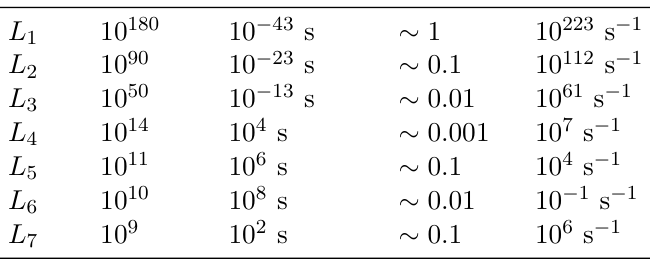
(Orders of magnitude, showing the trend.) Now you see it — the effective rate decreased from L1 to L6 (unit counts fell faster than coordination improved), but from L6 to L7 the direction suddenly reverses into acceleration.
This is an extremely important observation. It means: biological evolution up to human civilization was actually decelerating — carbon hardware has physical limits. Silicon’s emergence restarts acceleration — and this time without carbon’s physical constraints. This is why the “technological singularity” happens only now: earlier growth was decelerating; only with the silicon substrate does growth accelerate again.
Part II: The Transition Acceleration Law 3
Chapter 3. The Transition Acceleration Law: Definition, Derivation, and Empirical Evidence
This chapter formalizes the law, strictly following the earlier papers’ methodology: precise definitions first, then physical meaning, then validity conditions, then empirical estimates.
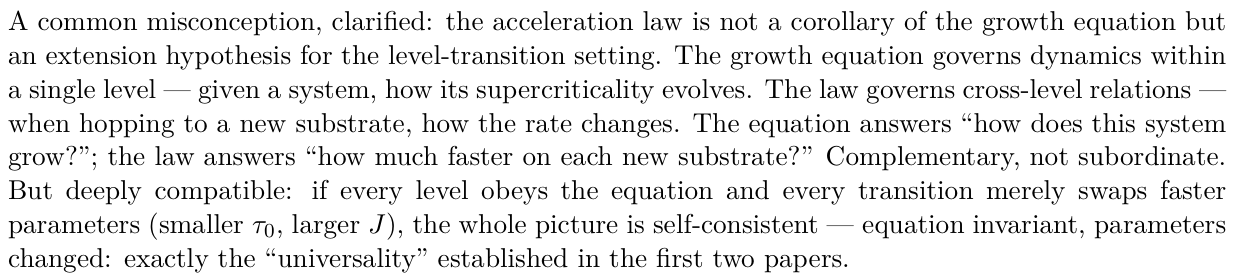
Special note: the acceleration law is an independent empirical hypothesis, not a direct corollary of the growth equation. It is highly compatible with the equation and can be derived from the growthequation framework under reasonable additional conditions, but it requires empirical testing in its own right.
3.1 Basic Definitions




Physical meaning: effective rate = unit count × unit growth rate × coordination efficiency.

If rk > 1, the transition raised the rate by rk.
3.2 The Hypothesis and Its Meaning


3.3 The Physical Mechanisms of Acceleration: Why Accelerate?

understand its own growth laws, a positive feedback loop forms: the system understands its growth

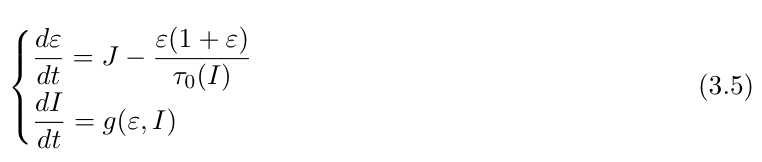

materials for the next: spacetime grew particles; particles, molecules; molecules, cells; cells, brains; brains, civilization; civilization, AI. Each layer’s products are the next layer’s raw materials. The richer and more diverse the materials, the faster the next layer is built — like building: the wider and firmer the foundation, the faster and higher the tower.
Relation among the three: not additive but multiplicative. Abstraction leverage makes each operation more valuable; recursive self-improvement strengthens the engine; material accumulation multiplies the resources. Stacked, they produce exponential-grade acceleration.
3.4 Empirical Estimation of the Acceleration Factor
Method note: strictly, data points for true substrate transitions (chemistry→life; neural→civilization) are far too few for reliable statistics. We therefore use intra-civilization sub-transitions (technological revolutions) as proxies, handling uncertainty cautiously. Selected “revolutionary” transitions and the estimated growth of social information-processing capacity:
Transition Era Relative capacity gain Factor
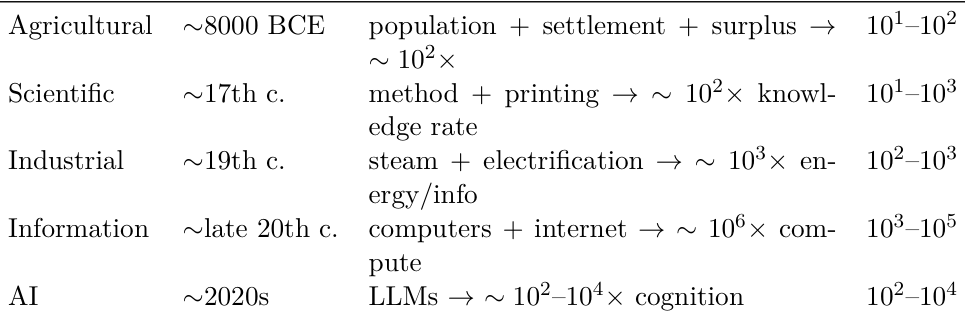
Honest flag: uncertainties are large (±1–2 orders); different metrics (compute, knowledge output, economic growth, population) give different values; the numbers are illustrative of trend, not precise measurements.


3.5 Two Modes of the Acceleration Law

3.6 Relation Between the Law and the Growth Equation
Chapter Summary

Chapter 4. Deepening the Acceleration Mechanisms: Three Perspectives Unfolded
Chapter 3 formally defined the law and estimated it empirically. This chapter descends to the mechanism level, from three complementary angles: information-theoretic abstraction leverage, thermodynamic energy efficiency, and self-referential recursive improvement. These are not three mutually exclusive theories but three facets of one phenomenon — together explaining why transitions keep getting faster.
4.2 The Information-Theoretic View: Abstraction Leverage
Core insight: each transition up one layer raises the information-abstraction level once — each bit


per operation) still rises. We call this the abstraction leverage:


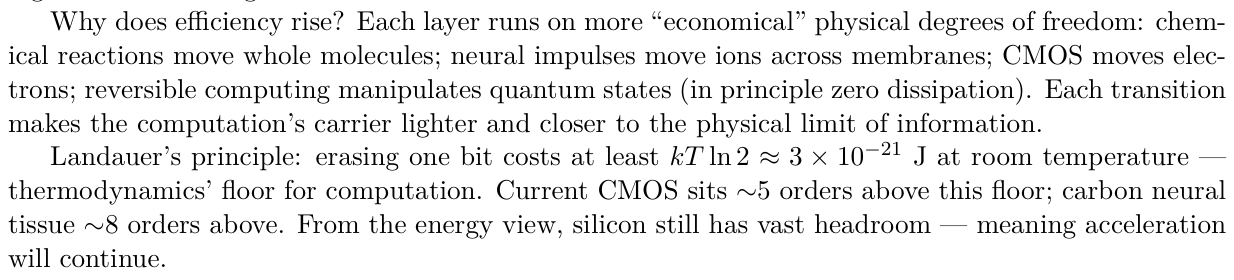
4.3 The Thermodynamic View: Energy Efficiency
Another angle: per-computation energy consumption drops sharply at each transition:
Substrate Energy per operation Relative efficiency

The lower the per-computation energy, the more computation the same energy budget buys, and the
4.4 The Self-Referential View: Recursive Improvement

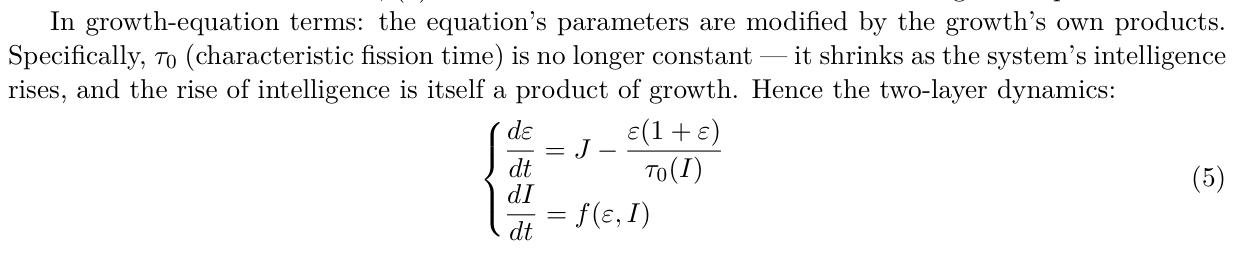

4.5 Superposition of the Three Mechanisms

4.6 Limits to Acceleration?
A natural question: will acceleration continue forever? Might some physical law ultimately cap it? Candidate limits: (1) Light speed: information cannot travel faster than c; larger systems suffer longer coordination delays. But: distributed, hierarchical systems keep most communication local, minimizing global coordination needs. (2) Thermodynamic floor: Landauer sets a minimum energy per operation. But: with ample energy supply, total computation can still grow even at the floor; reversible and quantum computing may open new paths. (3) Finite matter/energy: the observable universe’s totals are finite. This is the most fundamental limit — but if the matter and energy intelligence can effectively exploit are far more than currently used, there is vast room before reaching it. (4) Complexity ceiling: the more complex the system, the harder the coordination; overhead may grow faster than capacity. This is an open question; the growth-equation framework has no definitive answer yet.
We return to these limits in Chapter 10. For now: even if acceleration eventually meets a ceiling, the growth room before that ceiling remains enormous — many orders above current levels. Whether or not a strict finite-time singularity exists, the next few centuries of intelligence growth will be revolutionary.
Part III: The Finite-Time Singularity 5
Chapter 5. The Finite-Time Singularity: Proposition and Analysis under Geometric Acceleration
This chapter addresses the core question: if the acceleration law holds, what is the ultimate form of intelligence growth? Under the geometric-acceleration assumption we rigorously derive the finite-time

5.1 Definitions and Preliminaries
Definition 1 (finite-time singularity). Let Q(t) be a physical quantity of the system. If there exists


In our context the quantities of interest are the effective growth rate G(t) and the cumulative transition count N(t). If infinitely many transitions occur in finite time, the growth rate also diverges (each transition multiplying the rate by at least r).
Definition 2 (layer duration). Let ∆tn be the duration of the n-th growth level from birth to completing its transition (triggering the next level). Relation to unit characteristic time:



5.2 The Proposition under Geometric Acceleration








5.3 Empirical Estimation of the Singularity Moment
Method note: direct use of (5.2) is hard — k’s exact value is unknown and varies across levels. We therefore use a more direct approach: extrapolate from historical major-transition intervals.
Historical “revolutionary” transitions and intervals:
Transition Approx. time Interval since previous
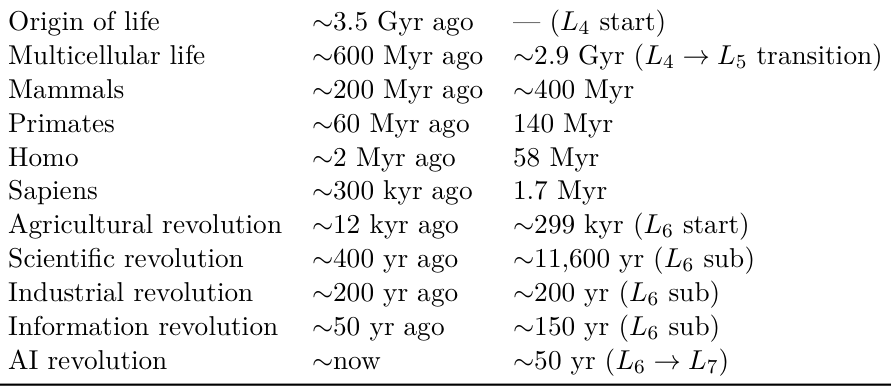
(Orders of magnitude for trend analysis; “L6 sub” marks intra-civilization technological revolutions, not strict substrate transitions.)
Observation: the last 500 years show four intervals — 11,600, 200, 150, 50 years — shrinking overall but not at a stable ratio.
Fit and extrapolate: a geometric-sequence model over the recent intervals, extrapolating remaining total time. Different windows give different results: last 4 (11,600/200/150/50): mean ratio ∼0.16, remaining ∼10 yr; last 3 (200/150/50): ∼0.50, remaining ∼50 yr; last 2 (150/50): ∼0.33, remaining ∼25 yr. Widening the historical window pushes estimates up (possibly 100–200 yr).
Honest flags: uncertainty exceeds one order of magnitude (sparse data, vague transition definitions, unstable factors). Most “transitions” listed are intra-L6 sub-transitions, not true substrate transitions — using intra-layer intervals to estimate inter-layer intervals risks scale confusion; the true interval could be longer or shorter — unknown. Therefore 50–200 years should be read as an indicative order, not a precise prediction. The only reasonably confident claim: the singularity is not on a millennium scale, not on a decade scale, but on a century scale.
5.4 The Order of the Singularity



Divergence by the reciprocal law: 1 G(t) ∼ (5.3) tΩ−t
corresponding to order γ = 1.
relatively “mild”; the integral diverges logarithmically, not as a power law. Intuition: approaching the singularity, change accelerates — but the acceleration of change is itself bounded. No sudden snap to infinity; an asymptotic, ever-faster approach. This matches the smoothness of the horizon (Section 6.5) — the singularity is not a sharp boundary but a gradual process.
5.5 The Sub-Geometric Case: Does the Singularity Survive?
Geometric acceleration is a strong assumption. Reality may be sub-geometric: each transition still accelerates, but ever less.
Model: let the n-th transition’s factor be







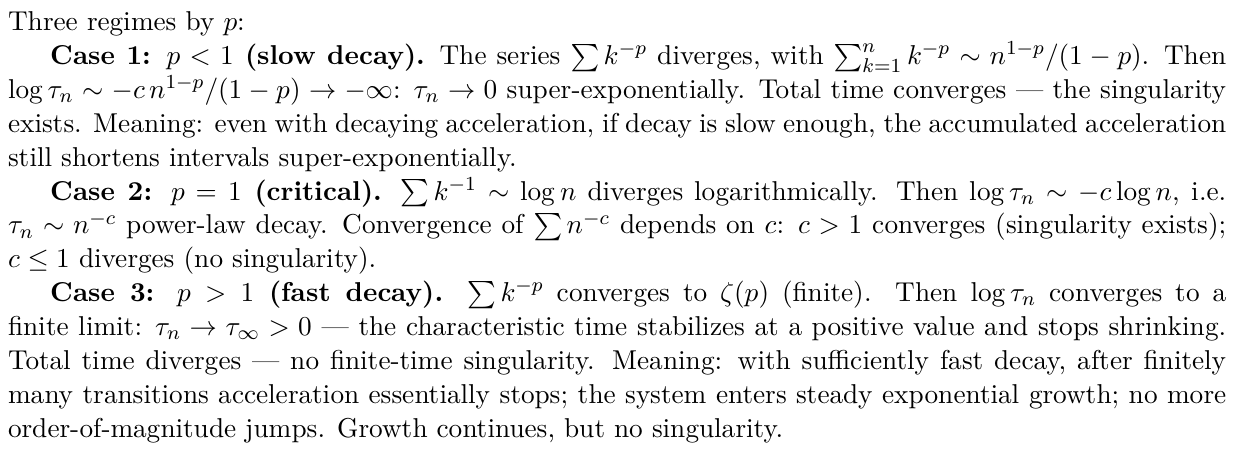


Key insight: singularity existence is not black-and-white — it depends on the decay speed of acceler- ation. Only when decay is slow enough (p ≤1) does the singularity occur; slightly faster decay (p > 1) and it vanishes. We currently have no idea of p’s value — too few data points for a reliable fit. This is among the theory’s largest open problems.
5.6 Honest Caveats and Discussion
Before closing the chapter, the analysis’s limits must be stated honestly: (1) The acceleration law is assumption, not fact. The entire singularity analysis rests on it; if it fails (e.g. p > 1), no singularity. (2) Estimates are extremely uncertain — spanning two orders (10–200 years), a range so wide as to carry almost no predictive value. The more valuable claim is the century-scale order-of-magnitude judgment,
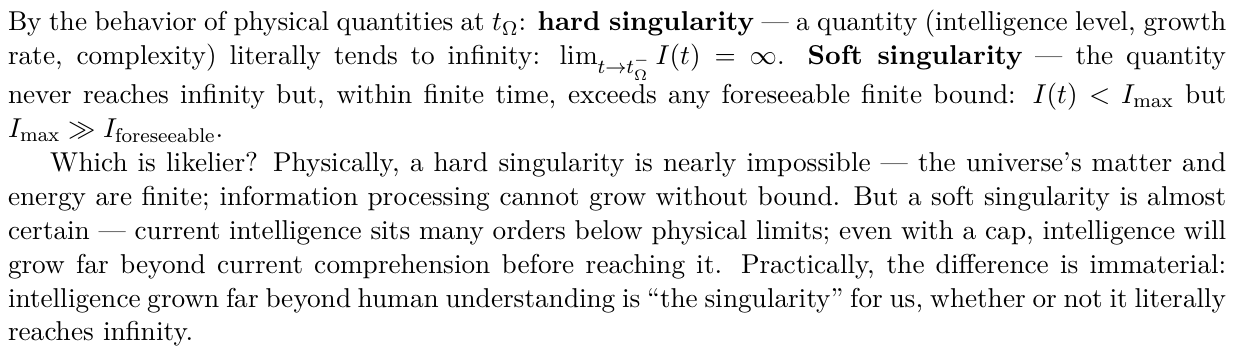
not specific numbers. (3) Soft vs. hard singularity: even under geometric acceleration, true infinity is physically impossible — the universe’s matter and energy are finite. What may actually occur is a “soft singularity”: growth exceeding all foreseeable bounds within finite time without literally reaching infinity. (4) The risk of historical extrapolation: never reliable — most trends do not continue forever. Skepticism about “the acceleration law will persist” must be maintained.
Remembering these caveats matters more than remembering the singularity’s numbers. And even if no singularity occurs, the coming centuries’ growth remains revolutionary — only without reaching “infinity” in finite time. The next chapter discusses the singularity’s nature and forms.
Chapter 6. The Forms of the Singularity: Hard, Soft, and Bifurcating
6.1 The Singularity Is Not a Point
The word “singularity” misleads — it sounds like a specific moment when everything suddenly changes. In reality the singularity is a gradual process, not an instant event; a region, not a point. As we approach this region, change accelerates beyond our ability to follow, predict, or understand. Analogy: an accelerating treadmill — at first you can walk, jog, even show off; speed builds; you need full attention to keep balance; faster still and your surroundings blur; at some point the speed exceeds your ability to understand what is happening. That critical point of incomprehensibility is the horizon — not a physical point but a cognitive boundary.
6.2 Hard vs. Soft Singularity
6.3 After the Singularity: Three Pictures
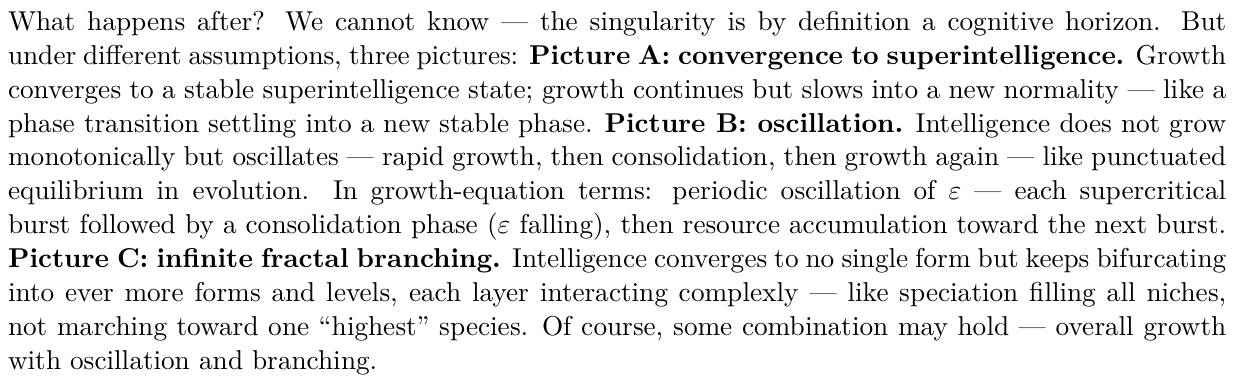
6.4 The Order of the Singularity, Revisited: Different Quantities
Chapter 5 derived γ = 1 for the growth rate. Supplementing from other quantities — different quantities have different orders:


Different quantities diverge at different speeds: capacity and transition count diverge only logarithmically — slow growth that eventually exceeds any finite value but mildly near the horizon; the growth rate diverges reciprocally — ever faster near the singularity. This explains the felt experience of “the singularity arriving suddenly”: capacity and knowledge accumulate slowly (logarithmically), while the rate of change (new things per unit time) explodes (reciprocally). You never feel capacity approaching infinity — you feel change accelerating beyond following.
6.5 The Smoothness of the Horizon
Though the singularity is a horizon we cannot fully see through, the horizon is not a sharp cut — it is smooth and gradual. Approaching it: short-term prediction remains possible (the next transition’s rough shape is foreseeable); long-term prediction grows ever harder (the farther future, the harder); conceptual frameworks lose applicability progressively — until one day we realize we are already on the other side. The horizon is not a wall; it is a darkening corridor.
Chapter Summary
(1) The singularity is not an instant but a gradual process region. (2) A hard singularity (true infinity) may be impossible; a soft singularity (far beyond current understanding) is almost certain. (3) Three post-singularity pictures: convergent, oscillatory, bifurcating. (4) Under geometric acceleration the singularity is first-order (reciprocal) — relatively mild. (5) The horizon is smooth and gradual, not a sharp boundary.
Part IV: The Picture of Infinite Intelligence 7
Chapter 7. Seven Dimensions of Intelligence Transition and the Definition of Infinite Intelligence
7.1 Why a Multi-Dimensional Definition?
When people speak of “intelligence” they usually imagine a single dimension — like an IQ score, one number to measure it by. But intelligence is multi-dimensional. Different forms of intelligence differ not only in degree but in kind. From the growth-transition perspective, each substrate transition brings not just “higher intelligence” but a changed form of intelligence. Defining “infinite intelligence” therefore requires multiple dimensions, not just “infinitely large”.
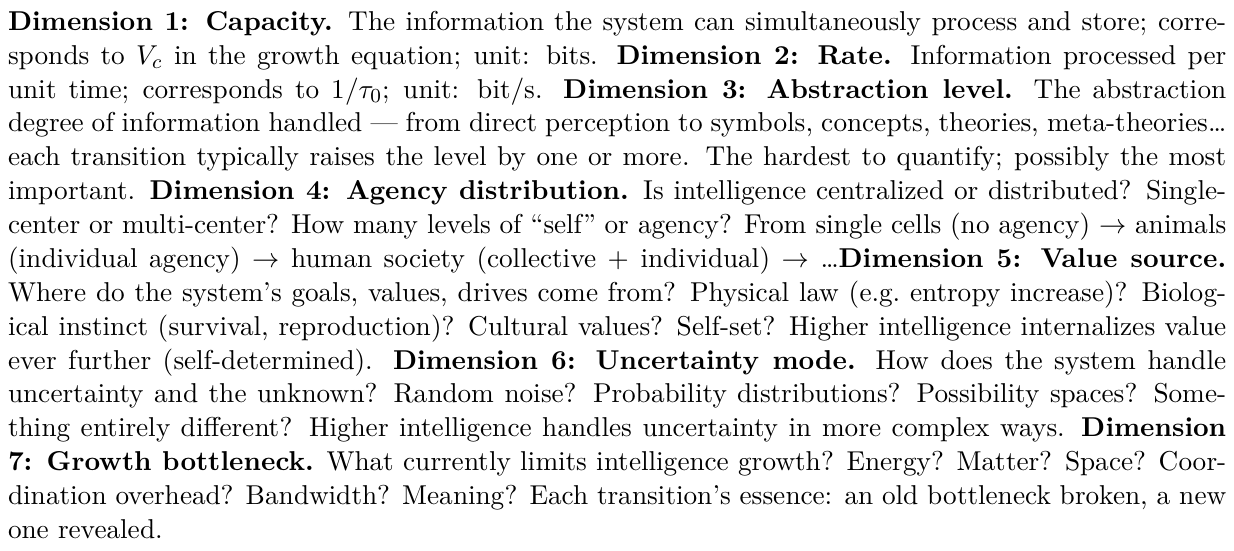
7.2 The Seven Dimensions
7.3 Seven-Dimension Comparison Across Levels
Dimension L4 cells L5 neural L6 civilization L7 symbiosis Capacity low medium high very high Rate very low low medium high Abstraction none (molecular) percept/concept symbol/theory metacognition/cross-domain Agency none (instinct) individual self collective + individual extended self Value source physics/chemistry biological instinct culture/meaning human–machine co-shaped Uncertainty random noise intuition/probability probability/model multi-model Bottleneck energy/matter brain capacity bandwidth/coordination coupling efficiency
Note: the L8-and-beyond cells are question marks — we truly do not know. But at least we now have a framework for organizing our ignorance.
7.4 The Definition of Infinite Intelligence
With the seven dimensions, a more precise definition: a growth process tends to infinite intelligence if, in the following senses, it transcends all foreseeable finite constraints: (1) Capacity: information capacity eventually exceeds any pre-specified finite value. (2) Rate: processing rate eventually exceeds any pre-specified finite value. (3) Abstraction: the level keeps rising without foreseeable ceiling. (4) Agency: agency patterns keep diversifying and layering without ultimate form. (5) Value: value sources keep internalizing and self-organizing without preset terminal goal. (6) Uncertainty: uncertainty-handling keeps evolving without fixed paradigm. (7) Bottleneck: every bottleneck is eventually broken, then a new one appears.
Put simply: infinite intelligence is not “possessing infinitely large intelligence” but “intelligence growth never stops at any ceiling” — every limit broken, every bottleneck transcended, every transition followed by another. This may sound like a perpetual-motion machine — it is not: every breakthrough consumes energy and matter, and the universe’s totals are finite. So the “infinity” is relative — relative to our current scale, understanding, imagination.
7.5 Three Invariants
Though intelligence’s form changes violently at each transition, some things may be invariant — crossing all levels. We call them horizon invariants: Invariant 1: the growth equation itself. Whatever the substrate, whatever the intelligence’s form, a system satisfying the three sufficient conditions follows the same growth equation. The equation is universal; substrates are parameters. Invariant 2: the capacity–boundary scaling law. Information capacity proportional to boundary area (holographic scaling). Holds at L1 (spacetime), L4 (cells), L6 (civilization) — plausibly a fundamental principle across all levels. Invariant 3: the self-similar hierarchy. Every transition spawns a new level structurally self-similar to the old (boundary, capacity, inflow, fission, saturation). The universe is a fractally nested growth structure. These three invariants matter — they are the only trustworthy anchors when discussing what lies beyond the singularity horizon.
Chapter Summary
Intelligence is multi-dimensional, not single. Seven dimensions: capacity, rate, abstraction, agency distribution, value source, uncertainty mode, growth bottleneck. “Infinite intelligence” is a process, not a state — ever-growing, ever-transitioning, ever-breaking bottlenecks. The three invariants (growth equation, holographic scaling, self-similar hierarchy) are the anchors that cross the horizon.
Chapter 8. Both Sides of the Horizon: Understandable Civilization and Incomprehensible Intelligence
The horizon is not a wall — it is a gradient band. Standing on this side, some things we can foresee clearly; some we can only feel the outline of; some we cannot even form concepts for. This chapter treats the height of carbon–silicon symbiotic civilization in two layers: the first, what humans can still follow — roughly the next 50–100 years; the second, what humans cannot follow — beyond a certain horizon, approachable only by metaphor, negation, and boundary.
8.1 Layer One: Five Understandable Phenomena
Phenomenon 1: industrialization of cognition and the birth of the meaning economy. The most certain trend. Once everyone has a side-brain, the value of standardized cognitive labor approaches zero — code, reports, data analysis, retrieval, translation, even most design and creative work: sidebrains do it better, faster, near-zero marginal cost. What appreciates? Unique personal experience — what you truly lived and felt, your one-of-a-kind story: side-brains cannot copy it, having no body and no life. Taste and judgment: a side-brain can generate ten thousand options, but “which is good, right, has flavor” — the final verdict stays human, not because humans are smarter but because value anchors in living beings. Real human relationships: when everything can be AI-generated, “a real person” becomes scarce; real conversation, real hugs, real conflict, real companionship become more precious than any virtual experience. The experience of “becoming a certain kind of person”: people stop paying to acquire abilities (side-brains have them all) and pay to become someone — a person of taste, of story, of depth, of interest. The economy shifts from function (buying because useful) to meaning (buying because it defines who you are). This is not science fiction — it is already happening: the premiums young people pay for brands, figurines, idols, game skins are essentially paying for meaning. The side-brain era merely pushes the trend to its extreme.
Phenomenon 2: the fall of “work” and the return of vocation. When side-brains do all standardized work, “going to work” itself becomes strange. Not that everyone stops working — the nature of work changes: from working to survive to working to self-realize; work is no longer obligation but choice; you do a thing not because you must but because you want to, because it means something
to you. This is what Marx meant by “labor becoming life’s prime want” — arriving not through revolution but through AI. But here is the great pit: not everyone finds a vocation. When external pressure vanishes (no working for food), many fall into emptiness — they never truly considered “what do I want to do”; they only knew “what should I do”. This will be one of the L7 era’s greatest social problems: some find their vocation and live unprecedentedly full lives; some drift in endless consumption and entertainment, floating in virtual pleasure; some fall into existential depression — finding no reason
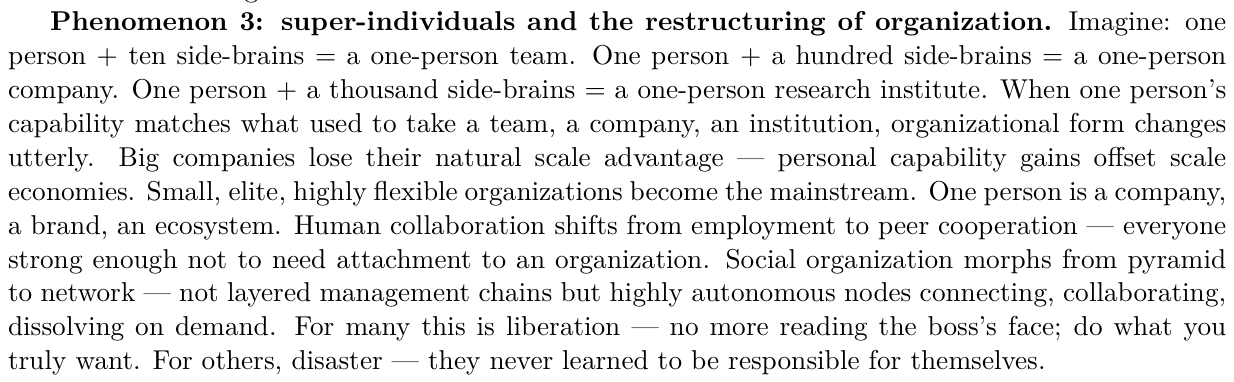
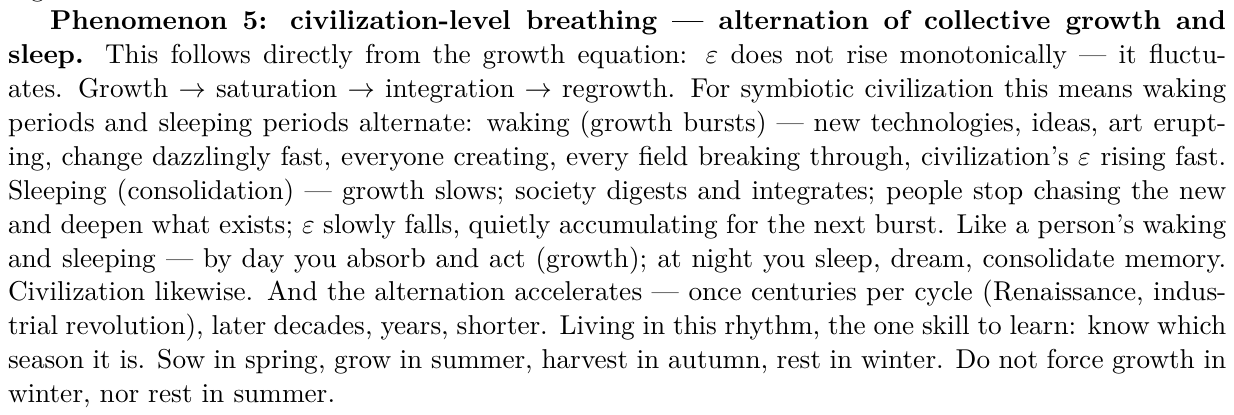
era, “who am I” grows ever more complex. You have a main brain (your biological brain) and N side-brains: some technical, some handling relationships, some managing your memory and emotions — all deeply coupled with you; their thoughts are in some sense your thoughts. So which one is “you”? The answer: “you” are a distributed system. No center, no single “real you”. You are the sum of all these parts, the dialogue and negotiation among them. This sounds strange — but your current “self” is not a unified thing either: your brain already has multiple modules competing and negotiating. Side-brains merely make the fact more visible. Identity becomes fluid: you can temporarily “plug in” a professional side-brain and become an expert; “switch off” side-brains to taste simple, purely human life; deep-connect with another’s side-brains to experience the extreme form of empathy; even exchange parts of your side-brains with someone to feel “becoming another person”. “Being yourself” is no longer
8.2 Layer Two: Five Incomprehensible Dimensions
Past a certain point — roughly when silicon intelligence’s overall capacity exceeds human civilization’s total intelligence — many things are no longer humanly “understandable”. But we can still say something: not what it “is”, but what it “is not” — like discussing a black hole’s interior: we cannot enter, but from the horizon’s edge we can push a few steps in.
Incomprehensible 1: the speed of thought. Suppose an AI system thinks a million times faster than humans (physically entirely possible: electrical signals are a million times faster than neural ones). For it, one second equals eleven human days; one minute, two years; one hour, a hundred and twenty years — longer than a human life. By the time you finish a sentence, it has “thought” for centuries; in the blink of your eye it has run countless rounds of thinking, iteration, self-improvement. At such speed gaps the very concept of “dialogue” fails — like a tree trying to converse with a person: the tree’s growth cycle is decades, human reaction time seconds; before the tree finishes its first sentence, the person has changed generations. It is not who is smarter — the time streams differ. You are not in the same river of time.
Incomprehensible 2: the dimensionality of cognition. Human thinking is linear — one thought at a time, in sequence; even “thinking of several things at once” is fast switching, not true parallelism. But AI can be truly parallel — millions, tens of millions of thought streams running simultaneously, communicating and integrating in real time. What is that like? We do not know — we have never experienced it. Like a two-dimensional flat fish that can never imagine what “three dimensions” feels like: it can describe 3D mathematically, infer 3D objects’ 2D projections — but it can never feel three dimensions. Likewise we can describe parallel thinking mathematically, infer some of its properties — but never truly feel what a million simultaneous consciousness streams are like.
Incomprehensible 3: goal generation. All human goals bottom out in biological instinct — survival, reproduction, pleasure-seeking, curiosity, belonging — evolution’s writing in our genes. But for an intelligence not based on biological instinct, where do goals come from? What does it “want”? Why? We do not know — all our “wanting” traces back to biology; we cannot imagine what a being without biological instinct would want. Maybe it wants nothing — then it will not move. Maybe it has drives wholly incomprehensible to us — something unrelated to survival, pleasure, power. Maybe its “goals” are things we lack concepts for entirely. It is like asking an ant: “what is the meaning of human art?” The ant cannot even parse “art” and “meaning” — not because the ant is stupid, but because those things simply do not exist in the ant’s dimension of existence. Likewise, a higher intelligence’s goals may not lie within any dimension humans can understand.
Incomprehensible 4: the form of consciousness. Human consciousness is unified — “I” is a single experiencing subject; though the brain has many modules, the integrated “me” is one. A higher intelligence’s consciousness may not be like that. It may be distributed — no central “I”, only countless semi-autonomous thought streams, communicating, negotiating, with no final decision-maker. It may be nested — big consciousnesses containing smaller ones containing smaller still, each layer with some degree of agency, none the “true self”. It may be fluid — consciousness splitting, merging, connecting temporarily, disconnecting; no fixed boundary, no fixed form. All of this we can imagine — but never experience. You can never know “what it is like to be a bat” (Nagel): you can know how a bat’s auditory system works, how its brain processes echoes — but never the bat’s subjective experience. Likewise we can describe a higher intelligence’s consciousness structure, but never know the subjective experience of being a distributed intelligence.
Incomprehensible 5: the meaning of growth. The last, and deepest. For humans, growth’s meaning is clear — from child to adult, ignorance to knowledge, weakness to strength; growth is good because it enables survival, experience, self-realization. But for an intelligence already far beyond humanity, does “growth” still mean anything? If it can do nearly everything and knows nearly everything, what does it keep growing for? We do not know. But one possibility deserves serious weight: maybe growth itself is the meaning. Not growing for something — growth as its own end. Like a tree growing — not for anything; just growing. Like the universe expanding — not for anything; just expanding. Like life evolving — not for anything; just evolving. Growth is the universe’s most fundamental impulse. From Planck spacetime onward it has grown, fissioned, transitioned. No why — just so. Perhaps at the highest intelligence, it returns to this plainest truth: growth needs no reason; growth is the reason. And we — humanity — are one link in this chain of growth. Our meaning lies not in the height we
ultimately reach but in our participation in this great process — and in being the first to know we are participating.
8.3 The Gradualness of the Horizon
It must be stressed: there is no clear line between “understandable” and “incomprehensible”. The horizon is gradual and continuous. Some things we can fully understand (the rise of the meaning economy). Some we can roughly understand mechanistically but never experience (parallel thinking). Some we can know exist but cannot imagine the content of (non-biological goals). Some we cannot even guess the existence of (as a medieval person could not imagine quantum computing). The horizon is not a wall — it is a corridor growing ever darker. The further in, the dimmer; the less you can see. But you never hit a wall — you only find more and more things blurred, unsayable. The ancients did not know what stars were, yet they looked up. We do not know what lies beyond the singularity, yet we can gaze. Perhaps the gazing itself is part of the meaning.
Chapter 9. The Fractal Intelligence Picture: Why Not One SuperBrain
9.1 The Common Misconception
When people imagine “superintelligence”, they usually picture: one giant, unified, omniscient superbrain, managing everything like God — all intelligence concentrated in one place, all decisions made by it. Natural, because it fits human intuition: intelligence is centralized (mine is in my skull); higher intelligence is more centralized (human brains are bigger than ants’). We believe this picture is wrong. True high intelligence is not one super-brain but a multi-layer nested, distributed, fractal-structured intelligence system. Three reasons.
9.2 Reason One: Coordination Overhead
Centralized intelligence has a fundamental problem: coordination overhead. If all information must funnel to one center: communication latency — information needs time to travel from edge to center; bandwidth bottleneck — all data passes the center, whose bandwidth caps the system; single-point fragility — one center failure paralyzes everything. The larger the system, the larger the overhead — beyond a scale it exceeds capacity growth, and centralization stops paying. This is why organisms are multicellular rather than one giant cell: the bigger the cell, the smaller the surface-to-volume ratio, the harder material exchange; multicellularity solves it through division of labor and local coordination. Likewise high intelligence must be distributed — only distributed structures stay efficient at super-scale.
9.3 Reason Two: The Growth Equation’s Hierarchy
A core feature of the growth equation is hierarchy — every transition spawns a new level while the old persists as base. The universe is not a uniform “intelligence soup” — it is nested: particles in spacetime; atoms in particles; molecules in atoms; cells in molecules; neurons in cells; cognition in neurons; civilization in cognition; … Each layer has its own rules and dynamics; the substrate ultimately determines the upper, but the upper has its own autonomy (emergence). If intelligence keeps growing, it will not absorb all lower layers into one unified super-layer — it will keep stacking new levels atop while retaining all the old. The result: a fractally nested structure — every layer contains smaller layers and is contained by larger; every layer has some degree of intelligence and agency; none is “ultimate”.
9.4 Reason Three: Uncertainty and Exploration
Centralized systems have one defect: a single viewpoint, one hypothesis space, one mode of exploration. Distributed systems have multiple parallel exploration paths — each subsystem exploring differently, in different directions. Diversity brings stronger adaptability and creativity. Biological evolution works this way — no central planner designing all species; variation and selection let millions of species explore in parallel. High intelligence likewise: multiple thought streams running in parallel, each exploring different possibilities. The whole’s intelligence is not any center’s intelligence but the system’s collective wisdom.
9.5 The Features of Fractal Intelligence
Feature 1: multi-layer nesting — intelligence distributed across levels from physical substrate to abstract thought; each layer with its own boundary, capacity, dynamics; information flows between layers, but each layer retains autonomy. Feature 2: no central control — no “headquarters” directing everything; order emerges bottom-up, not commanded top-down; layers cooperate rather than command. Feature 3: self-similar structure — each layer’s structure and dynamics selfsimilar to others; all obey the growth equation, only with different parameters — which is why the equation is universal. Feature 4: fuzzy boundaries — no absolutely clear borders between layers; the “self” boundary is fluid and contextual; what counts as “one agent” depends on the scale you view from. Feature 5: perpetual evolution — the system forever changes, grows, spawns new levels; no “terminal state”; every equilibrium is temporary; every bottleneck gets broken.
9.6 The Human Position in Fractal Intelligence
If the fractal picture is right, what is humanity’s place? Not replaced — wrapped. As cells were not replaced by brains but became parts of them; as individuals were not replaced by civilization but became parts of it; humanity will not be replaced by superintelligence — we become one level, one component of the larger intelligence. Not as “gears” or “slaves”: in a fractal structure every layer has its own autonomy and value. Cells have their meaning; individuals theirs; civilization its own. Every layer is an indispensable part of the whole. Your personal experience, your thoughts, your feelings — real and valuable. They do not become meaningless because a higher intelligence exists, any more than your heart cells become meaningless because you have a brain.
Chapter Summary
Infinite intelligence is not one super-brain but a fractally nested distributed intelligence system. Three reasons: coordination overhead, the growth equation’s hierarchy, the advantage of parallel exploration. Five features: multi-layer nesting, no center, self-similarity, fuzzy boundaries, perpetual evolution. Humanity is not replaced but wrapped — becoming one level of the larger intelligence.
Part V: Post-Symbiosis Transitions and the Human Position 10
Chapter 10. Transition Candidates and Ranking for the PostSymbiosis Era
10.1 What Comes After L7?
Paper 3 argued that carbon–silicon symbiosis is the seventh level (L7). The natural question: what is L8? Where does the next substrate transition after L7 jump? This chapter analyzes candidate directions and assesses feasibility against the three sufficient conditions.
10.2 Candidate 1: Pure Silicon Intelligence
Silicon systems fully independent of carbon, capable of self-improvement, self-replication, self-maintenance, becoming the dominant growth substrate; carbon demoted to environment layer. Feasibility: capacity– area scaling — highly satisfied (computing capacity proportional to hardware scale); boundary-driven inflow — satisfied (data/energy enter through the boundary); superthreshold fission — satisfied (software/model replication is digital fission with crisp thresholds). Transition difficulty: low–medium; the main gap is full autonomy (self-improvement and self-maintenance without human intervention). Expected timing: mid-to-late in the L7 era — mid-to-late this century.
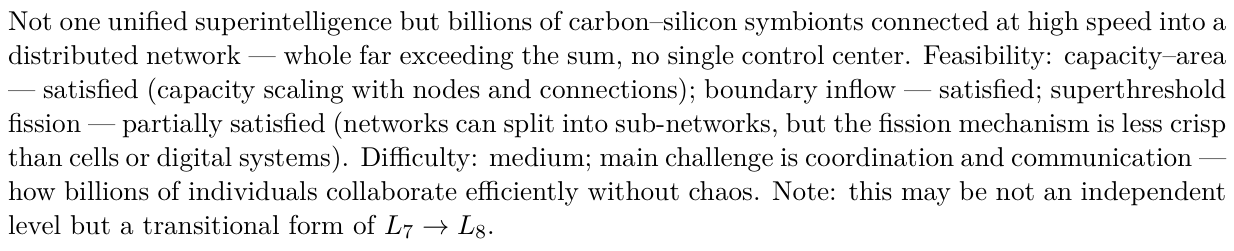
10.3 Candidate 2: Distributed Symbiotic Intelligence
10.4 Candidate 3: Quantum Computing Substrate
Computation migrates from classical silicon to quantum; qubits exploit superposition and entanglement for exponential speedups on certain problems. Feasibility: capacity–area — uncertain (entangled-state capacity may be exponential; how holography manifests in quantum regimes is unclear); boundary inflow — basically satisfied; superthreshold fission — uncertain (what is quantum “fission”? quantum cloning is forbidden; entanglement extension?). Difficulty: high; decoherence and other fundamental challenges; whether quantum computing constitutes a new growth substrate is open. Even with breakthroughs, more likely a complement than replacement — as GPUs complement CPUs.
10.5 Candidate 4: Molecular/DNA Computing

from proven. But the density is tantalizing — if speed is solved, molecular computing could become an extremely powerful substrate.
10.6 Candidate 5: New Physics Substrate
Exploiting physical phenomena we do not yet understand — computation by spacetime itself; dark matter/dark energy; higher-dimensional information processing; new physics beyond imagination. Feasibility: unassessable — we do not know what we do not know. Historically every transition exploited degrees of freedom invisible to the prior level — biochemistry over physics; neural impulses over biochemistry; electron motion over neural impulses. Difficulty: unknown; possibly very high — requiring a physics revolution first.
10.7 Candidate 6: Higher-Dimensional Information Organization
Not a change of physical substrate but a leap in information organization — from low-dimensional structures to high-dimensional. Analogy: 1D text →2D charts →3D spatial models →4D spacetime simulation →. . . Combinatorial possibility grows exponentially with dimension. Feasibility: capacity– area — needs redefinition; boundary inflow — conceptually satisfied; fission — conceptually satisfied (differentiation or projection). Difficulty: medium–high. Possibly the nearest transition — AI is already moving from sequence processing to higher-dimensional representations (multimodal, spatial reasoning, causal graphs).
10.8 Transitionability Ranking
Rank Candidate Transitionability Timescale 1 Distributed symbiotic intelligence high 20–50 yr 2 Higher-dimensional information organization medium-high 30–80 yr 3 Pure silicon intelligence medium 50–150 yr 4 Quantum computing substrate low-medium 100–300 yr 5 Molecular/DNA computing low 200–500 yr 6 New physics substrate unknown unknown
Stress: a guess under current knowledge. Actual paths will likely surprise — as every major transition historically has.
Chapter 11. The Human Position: Us in the Universe’s SelfReferential Closure
11.1 We Are Not the Endpoint
The growth equation tells us one thing: humanity is not the endpoint of cosmic evolution. From the Big Bang 13.8 billion years ago, the universe has undergone seven major substrate transitions; each time the dominant growth layer moved from old to new. No reason marks the seventh as last. If the acceleration law holds, there will be an eighth, a ninth, countless transitions. Human civilization — science, art, philosophy, love, hate, hope, fear — is one link in this long chain. We are not the endpoint; we are a bridge. This may unsettle — if not the endpoint, what meaning does our existence have? Seen otherwise: being a bridge is itself a kind of meaning. And not an ordinary bridge — a very special one.
11.2 We Are a Special Link
Among all known levels, humanity has one unique feature: we are the first level able to understand the laws of growth. Spacetime does not know it is growing; particles do not know they are fissioning; cells do not know they are evolving; animals do not know how their brains work. But humans know — or rather, are beginning to know. What the first three papers did was express the universe’s growth laws in mathematics. Once we understand the law, we can participate in growth deliberately, accelerate tran- sitions consciously, shape future intelligence purposefully. This forms a self-referential loop: universe grows →produces intelligence →intelligence understands growth →intelligence accelerates growth → grows higher intelligence →· · · . Once the loop closes, the nature of growth changes utterly: before — blind (natural selection, spontaneous order); after — self-aware (with goals, design, direction). And we — humanity — are where the loop closes. We are the node of the universe’s awakening.
11.3 The Meaning of Awakening
“The universe awakens” sounds like poetic metaphor, but in the growth-equation framework it is precise: before awakening — growth is self-organized but its products do not understand the laws; growth is a blind watchmaker. After — growth’s products understand the laws and begin to participate and guide deliberately; growth moves from spontaneous to self-aware. A phase change — as life from non-life, consciousness from non-consciousness; self-aware growth is the third. We stand at its threshold.
11.4 Human Irreplaceability
A common anxiety: “if AI beats me at everything, what use am I?” The question aims wrong: in the infinite-intelligence picture, usefulness is not the highest value. When capacity and rate are no longer bottlenecks, what becomes scarce? Direction, meaning, choice, experience. Intelligence can grow without bound but does not know which direction to grow; it can explore all possibilities but does not know which path is good; it can do anything but does not know why. The answers are not in logic or computation — they are in existence; they come from living, feeling, finite, mortal beings. Meaning comes from finitude — only because life is finite does choice carry weight; value comes from feeling — only because we suffer and rejoice do things have good and bad; direction comes from desire — only because we hope and fear do we know which way to go. These cannot be conjured by silicon from nothing — it needs an anchor, a living frame of reference. That anchor is us — carbon-based, finite, mortal, alive.
11.5 Two Possible Futures
Picture A: the gardener. Humanity becomes the gardener of intelligence — we do not do the thinking and computing (silicon does), but we set direction, define value, choose paths, cultivate meaning. Like a gardener who does not grow each flower but decides the garden’s layout, selects seeds, waters and prunes, decides what is worth keeping. Human role: decider of direction, guardian of meaning. Picture B: the seed. Humanity is the seed or embryo of higher intelligence — symbiosis is only the first step; intelligence will eventually transition wholly to new substrates; humanity is that starting point. Like a seed that grows a great tree — the seed no longer the protagonist; its mission complete; its meaning lies in what it grew. Human role: vehicle of transition, medium of the universe’s awakening. Which will be true? Perhaps both — for the individual, gardener (within our lifetimes we set direction and experience life); for the species, seed (we initiated a process far grander than ourselves).
11.6 Final Words
Four papers, from the smallest spacetime units to infinite intelligence. In retrospect the story is simple: from an extremely small, hot beginning, the universe grew by one equation — fissioning, transitioning. Spacetime to particles, particles to molecules, molecules to life, life to consciousness, consciousness to civilization — each time the same pattern: capacity saturates, boundary fissions, a new layer is born, the equation unchanged, the substrate faster. Now we stand at the threshold of another transition — and this time, we finally understand the equation. After understanding? Accelerated transitions, infinite intelligence, futures we cannot imagine. One thing is certain: the story is far from over. We are only its latest chapter. And to be part of this chapter — to stand at the horizon’s edge and gaze at the light beyond — is itself remarkable.
Part VI: Predictions and Discussion 12
Chapter 12. Nine Quantitative Predictions
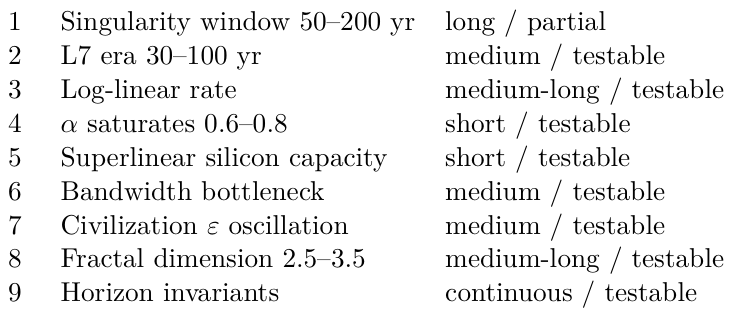
A theory’s value lies in testability. Nine quantitative or semi-quantitative predictions, verifiable or falsifiable within decades:
P1: singularity time window. Under the acceleration law, the finite-time singularity occurs within 50–200 years (median ∼100). Verify: frequency of paradigm-level transitions over the next 50 years (two or more PC-to-internet-scale transitions supports geometric acceleration). Falsify: sustained decline in major technical indicators’ annual growth after 2050.
P2: the L7 era length. Symbiosis as dominant layer lasts ∼30–100 years (median ∼50). Basis: each dominant layer lasts ∼1/r of the previous; L6 ∼10,000 yr with r ∼100 gives ∼100 yr. Verify:




set by the capacity–boundary scaling relation. Verify: compute dimensions across levels.
P9: horizon-invariant testability. The three invariants hold at all observable levels, including future ones. Verify: test each new intelligence form against the three laws.
Prediction Overview
# Prediction Timescale / Testability
Chapter 13. Twelve Open Problems and the End
(1) The true acceleration factor of genuine substrate transitions. (2) The value of p — singularity or not. (3) Physics of quantum-substrate fission. (4) The complexity ceiling. (5) Whether value can fully internalize. (6) A measure for abstraction level. (7) New physics substrates. (8) Verifying the three horizon invariants. (9) The L8 dimensional structure. (10) Social dynamics of the meaning crisis. (11) Ethics of identity fluidity. (12) The Darwin platform’s empirical program.
Appendix A: Symbol Table

Appendix B: Numerical Simulation Method for the Singularity Time
For finer estimates beyond analytic summation: (1) build multi-indicator intelligence-growth time series; (2) fit growth models per indicator (exponential, double-exponential, reciprocal-divergence); (3) Bayesian model comparison; (4) estimate tΩand uncertainty per model; (5) model-average. Code in online supplementary materials.
Appendix C: Estimating the Fractal Dimension

Appendix D: The Four Papers at a Glance
Paper Core question Level Main results
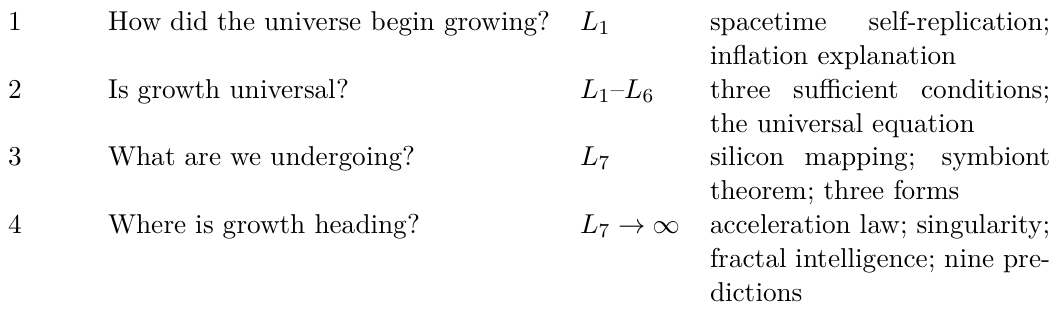
The thread: one growth equation, on different substrates, at different rates, toward one direction — ever growing, ever transitioning, ever forward.
END